
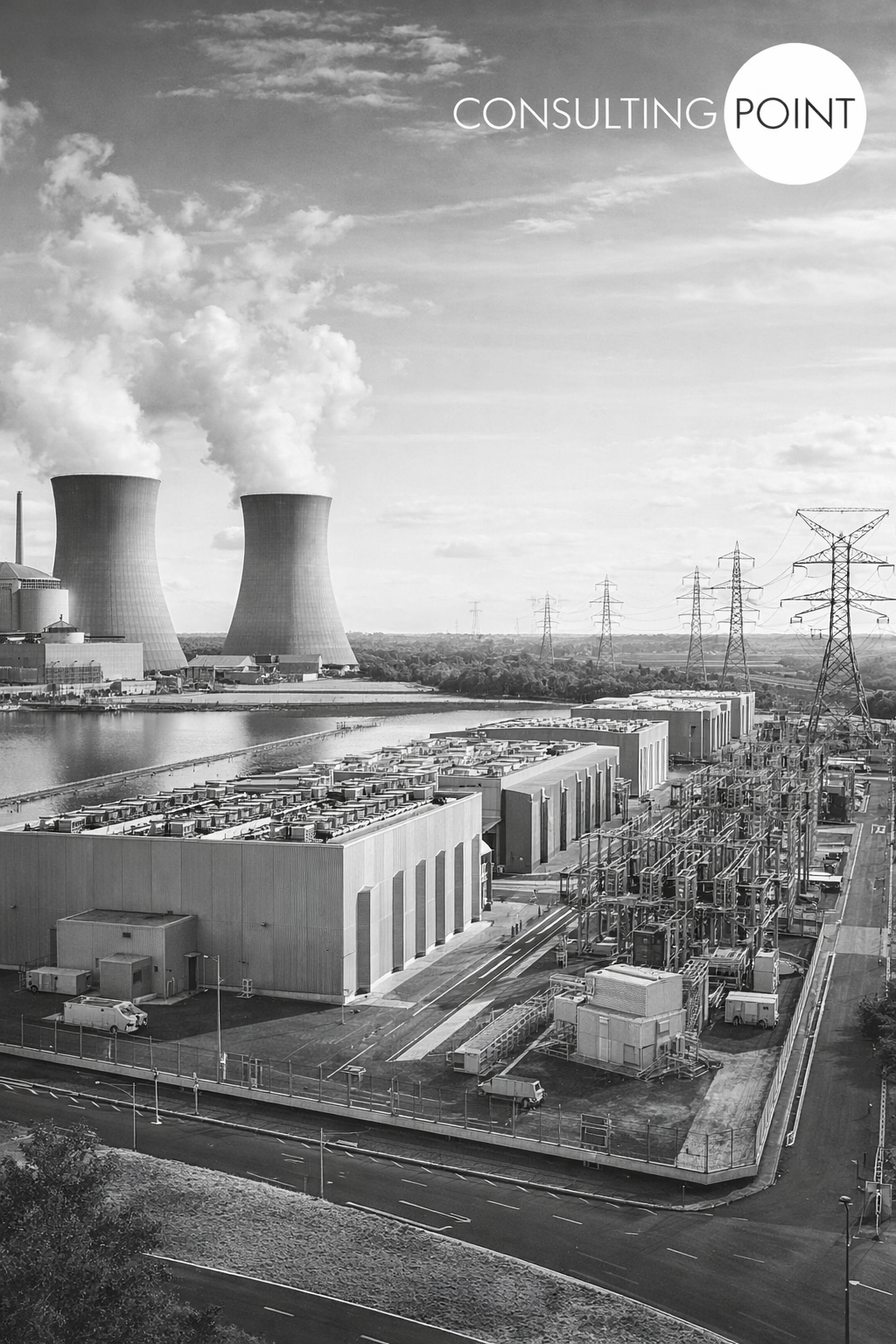
Consulting Point observes renewed global momentum behind nuclear energy. Over the past year, China has continued to expand at a pace, Japan has shifted policy towards maximising nuclear use, and Europe and the United States have maintained support for existing fleets while investing heavily in new technologies.
This direction aligns with rising demand for reliable, low-emissions baseload power. Nuclear is increasingly positioned as a stabilising component of national energy systems rather than a transitional solution.
The political risk embedded in nuclear development
Despite strong policy signals, nuclear remains acutely exposed to political change. Projects develop over decades, while governments operate on electoral cycles measured in years.
Shifts in administration can alter permitting timelines, funding structures, and public acceptance. This structural mismatch between political horizons and project lifespans continues to generate regulatory and investment uncertainty across the sector.
Investment growth across the value chain
Global investment in nuclear is forecast to exceed $2 trillion over the coming 25 years, with installed capacity expected to more than double by mid-century. While China accounts for a substantial share of this expansion, ambitions are broadening across developed and emerging markets.
The United States, France, Belgium, Japan, South Korea, and several countries in central and eastern Europe are all pursuing new build, life extension, or export-led strategies. Similar momentum is visible in the Gulf, where large-scale projects and small modular reactors are under active consideration.
The UK landscape: ambition meets delivery
In the UK, the government maintains an ambition to reach up to 24 GW of nuclear capacity by 2050. Consulting Point notes that achieving this target will depend on regulatory coordination, planning reform, and execution discipline.
Recent policy direction has emphasised proportionate regulation, closer alignment between public bodies, and greater cooperation with overseas regulators, particularly for small modular reactors. These measures aim to reduce delays while maintaining safety and public confidence.
Financing reform and the role of Sizewell C
The UK nuclear fleet is approaching a period of contraction, with most existing stations scheduled to close by the early 2030s before new capacity comes online. Against this backdrop, the Sizewell C project marks a critical milestone.
As the first UK nuclear project financed under a regulated asset base model, Sizewell C represents a shift in risk allocation. Cost recovery during construction reduces financing costs and broadens the investor base, placing greater emphasis on regulatory stability, performance incentives, and long-term governance.
SMRs, advanced reactors, and fusion
Alongside large-scale projects, momentum behind small modular reactors continues to build. In the UK, site selection and technology decisions signal a move from concept to deployment, supported by international partnerships and government coordination.
Advanced modular reactors offer further optionality, particularly for industrial heat and specialist applications. While fusion remains longer-dated, sustained private investment and growing regulatory attention suggest increasing confidence in its future potential.
What this means for investors and corporates
Consulting Point believes the next decade will be defined by volatility rather than retreat. Temporary reductions in nuclear capacity may place upward pressure on power prices and increase reliance on alternative generation sources.
At the same time, the growth of AI and data-intensive industries is strengthening the strategic case for nuclear, given its reliability and low-carbon profile. These dynamics create opportunity across the nuclear value chain, but political continuity remains the critical variable shaping long-term outcomes.
Nuclear energy is re-establishing itself as a core pillar of national energy strategies. However, sustained success will depend on aligning long-term investment frameworks with short-term political realities, ensuring confidence for sponsors, investors, and the wider energy system.